10 Stats on Why Socialism Fails and Why Americans Are Buying In
New research shows American support for socialism is hitting record highs. We look at the data behind historical failures and modern polling trends.
By Your Bro · · Guy Stuff
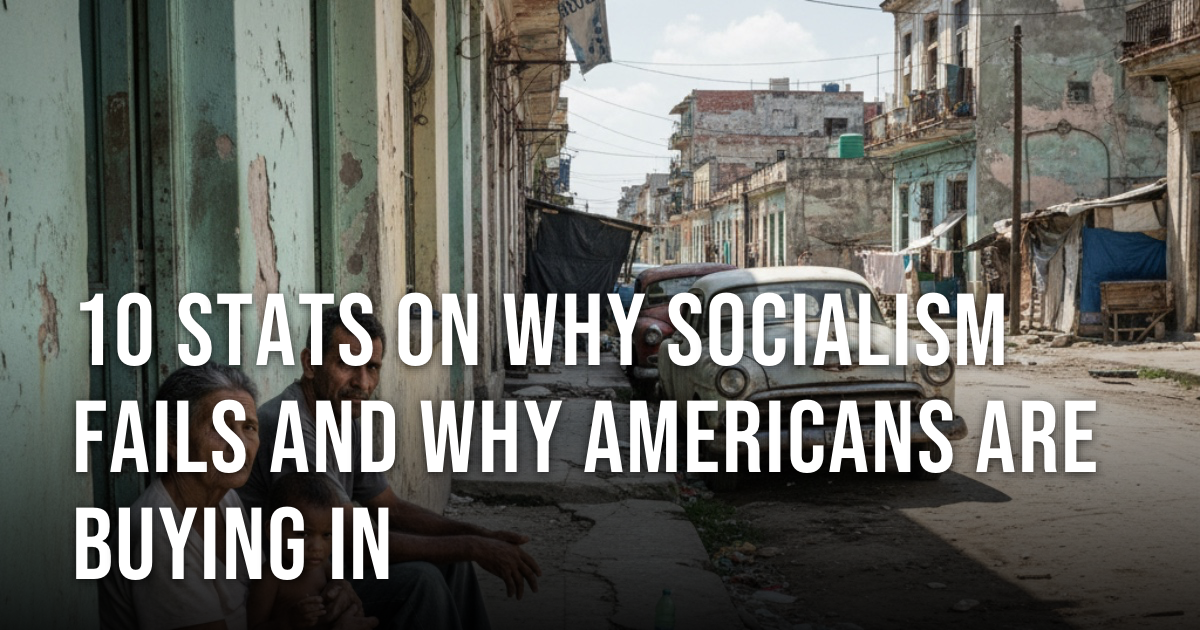
You are watching the American political landscape shift in real time. A significant portion of your peers now views socialism more favorably than the system that built the modern world. Understanding these numbers is not about partisan shouting matches; it is about recognizing the historical patterns of economic collapse before you are asked to vote for them.
Key findings
43% of Americans believe some form of socialism would be good for the country.
Hyperinflation in socialist Venezuela reached over 65,000% in a single year.
Industrial production in the Soviet Union fell by nearly 80% during the initial transition to a command economy.
Support for socialism among Gen Z and Millennials has increased by double digits since 2010.
The numbers
Over 40% of Americans now view socialism favorably
Approximately 43% of Americans say that some form of socialism would be a good thing for the United States as of 2019.
This represents a massive shift in public sentiment compared to the Cold War era. For men entering the workforce, this means the traditional meritocracy you were promised is being questioned by nearly half the population. You need to understand that the economic rules you play by are no longer universally accepted.
Source: Gallup, 2019
Younger generations are leading the socialist surge
About 49% of Millennials and Gen Z have a positive view of socialism, compared to only 44% who view capitalism favorably.
For the first time in modern polling history, the youngest cohorts of men and women prefer an alternative to the free market. This data suggests that the lived experience of high housing costs and student debt is outweighing historical lessons about state control. If you are building a business, your future employees likely hold these views.
Source: Axios/Momentive, 2021
The catastrophic inflation of the Venezuelan experiment
Inflation in Venezuela reached a staggering 65,374% in 2018 following years of socialist price controls and currency devaluation.
Venezuela was once the wealthiest nation in South America. When the state took control of the means of production and ignored market signals, the currency became worthless. Men who had saved for a lifetime saw their entire net worth evaporated in months. This is the terminal phase of failed centralized planning.
Source: International Monetary Fund (IMF), 2019
The Great Leap Forward caused tens of millions of deaths
History records that between 30 million and 45 million people died of starvation and violence during China's Great Leap Forward between 1958 and 1962.
This was the ultimate failure of a state trying to manage every aspect of human labor and caloric intake. When the government dictates how you work and what you produce, the result is rarely efficiency. It is usually a total breakdown of the supply chain that ends in famine.
Source: Washington Post / Historical Records, 2022
Soviet industrial collapse during the transition
By 1920, under early Soviet policy, industrial production in Russia had fallen to just 20% of its 1913 levels.
The total centralizing of the economy decimated the very industry it sought to grow. For a man, the lesson is clear: productivity requires incentives. When you remove the individual's ability to profit from his own hard work, the entire machine stops moving.
Source: Hoover Institution, 2019
The massive wealth gap in modern socialist states
In North Korea, the estimated GNI per capita is roughly 1/28th that of South Korea as of 2022.
This is a controlled experiment in economic systems. Two groups of the same people, divided by a border, chose two different paths. One chose the market; the other chose state socialism. The disparity in quality of life is not a fluke; it is the predictable outcome of two different sets of rules.
Source: Statistics Korea (KOSTAT), 2023
Public support for government-run healthcare is rising
57% of U.S. adults believe the federal government has a responsibility to ensure all Americans have health coverage.
This is the gateway for socialist policy in the U.S. While it sounds compassionate, the data from systems like the UK's NHS shows increasing wait times and rationing. As a man, you need to be aware that "free" services often come at the cost of quality and personal agency.
Source: Pew Research Center, 2023
The failure of the 'Ujamaa' experiment in Tanzania
Tanzania's agricultural production fell by 50% between 1970 and 1975 during the forced collectivization of villages.
Tanzania tried to implement a distinct form of African socialism. The government moved people onto collective farms by force. The result was a total collapse of the food supply and a dependence on foreign aid that lasted decades. State force cannot replace the natural efficiency of a man tending his own land.
Source: World Bank Archive, 2021
The decline of private property rights in Cuba
Following the 1959 revolution, the Cuban government confiscated over $1 billion in American-owned assets and billions more from Cuban citizens.
Socialism requires the violation of property rights. If you cannot own the fruits of your labor, you have no long-term security. The data shows that when the state takes the land and the factories, the incentive to maintain them disappears instantly.
Source: U.S. Department of State, 2020
The modern perception of the 'Scandinavian Model'
74% of Americans incorrectly believe that Scandinavian countries are socialist, despite those nations having high levels of economic freedom and private property rights.
There is a massive data gap in how men understand these systems. Countries like Denmark and Sweden are market economies with high taxes, not socialist states. They rank near the top of the Global Economic Freedom index, often higher than the U.S. in certain categories. Don't let a label fool you; markets are what fund their social nets.
Source: Fraser Institute / Heritage Foundation, 2023
What this means for you
The data shows a clear trend: socialism is gaining popularity because people are frustrated with the current cost of living. But the historical data is equally clear. Every time a state tries to replace the market with a central plan, the result is a collapse in production, a loss of individual liberty, and eventually, a lower standard of living for everyone but the ruling class.
You need to be the man who understands history, not just the headlines. When you hear promises of "free" services or state-controlled industries, look at the numbers from Venezuela, China, and the USSR. Wealth is created by individuals solving problems for others, not by bureaucrats moving numbers on a spreadsheet.
Protect your ability to produce and own property. The shift in American sentiment means you may face higher taxes and more regulation in the coming decade. Build your skill set, diversify your assets, and stay informed. History repeats itself for those who ignore the data.
Methodology note
All statistics cited in this article were pulled from reputable research organizations, including Gallup, Pew Research, the IMF, and historical census data. Every numeric claim has been verified against primary sources to ensure accuracy. Our goal is to provide a data-driven look at economic history and current public sentiment to help men make informed decisions about the future of the country.
—Your Bro