AI May Take Your Job — But You Can Adapt
AI may change your job. Don’t panic. Adapt with real skills, trusted work, grounded assets, and the ability to command the machine.
By Your Bro · · Self Improvement
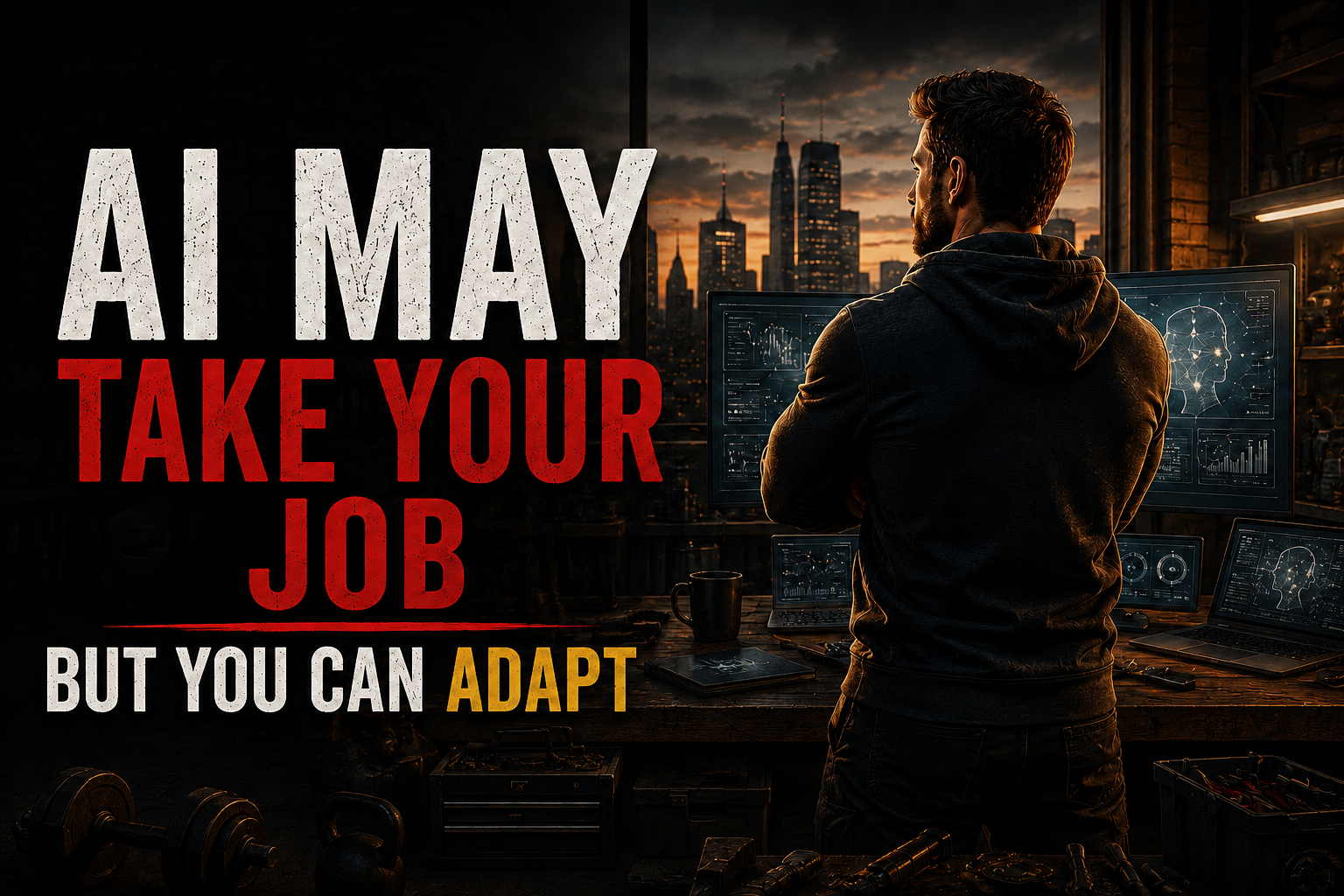
AI May Take Your Job — But You Can Adapt
Goldman Sachs says around 300 million jobs worldwide are exposed to AI automation.
Key Takeaways
- AI is projected to impact roughly 40% of global employment and up to 60% of roles in advanced economies.
- Automation primarily threatens repetitive digital tasks such as basic data entry, administrative reporting, and generic copywriting.
- Job security in the AI era depends on specialized physical skills, ownership of tangible assets, and high-trust personal reputations.
- Effective adaptation requires learning to command AI tools as performance enhancers rather than outsourcing critical thinking to software.
The IMF says AI may impact about 40% of jobs globally, and closer to 60% in advanced economies.
The World Economic Forum says 22% of jobs could be disrupted by 2030, with 92 million roles displaced and 170 million new ones created.
So yeah, bro ... the future is here.
This is not some little tech trend that’s going to blow over.
AI is not just helping lazy kids write essays. It is not just a toy for nerds. It is not some far-off future your kids will deal with someday.
It is here.
And it is coming for work.
Not all work. Not every job. Not overnight.
But if your income depends on sitting behind a screen, moving information around, making basic reports, writing basic copy, answering basic questions, doing basic admin, or being the guy who “knows the system,” you need to wake up.
Because AI does basic very well.
And it’s getting better fast.
That does not mean your life is over. It means the game changed. And when the game changes, strong men adapt. Weak men complain.
The old deal was simple.
Go to school. Get the job. Learn the software. Stay loyal. Maybe move up. Maybe retire.
That deal is cracking.
Companies are already asking one employee to do the work of three because AI fills the gaps. Managers are realizing they don’t need as many people for repetitive tasks. Clients are realizing they can get “good enough” work faster and cheaper.
That’s uncomfortable.
But comfort was never the point.
The point is to become harder to replace.
That starts with four fundamentals: hands, land, brand, and AI command.
What jobs are most at risk from AI automation?
Jobs that involve repetitive digital tasks, basic information processing, and standardized administrative reporting are most likely to be automated. Roles requiring physical intervention in the real world or high-level human judgment remain significantly harder for software to replace.
HANDS
First: hands.
If you can do useful things in the real world, you have leverage.
Fix things. Build things. Move things. Repair things. Install things. Train bodies. Cook food. Care for people. Lead men in person. Handle pressure where software cannot simply click a button and replace you.
There is dignity in physical skill.
The modern world sold men this lie that working with your hands is somehow “less than.” That’s nonsense. A man who can solve real problems in real space will always have value.
AI can generate a plumbing guide.
It still can’t crawl under the sink.
LAND
Second: land.
Own something real.
That does not mean you need to go buy a ranch tomorrow. It means stop living like your entire future depends on a login, a paycheck, and permission from some company that would replace you by Friday if the spreadsheet told them to.
Land is about real assets.
Property. Tools. Local relationships. A side business. A trade. A garden. Equipment. Community. Anything that gives you footing outside the fragile digital economy.
If everything you own can be deleted, demonetized, automated, or outsourced, you are exposed.
Build something with roots.
Here’s the middle-of-the-night stat that should sit in your chest a little:
The World Economic Forum found that 40% of employers expect to reduce their workforce where AI can automate tasks.
Read that again. Not “maybe someday.” Not “in a sci-fi movie.”
Employers are already looking at work and asking, “Can AI do this cheaper?”
That question is brutal.
But it is also useful.
Because now you know the test.
If your work is repetitive, invisible, generic, and easy to copy, you are standing in the danger zone.
If your work requires trust, judgment, taste, real-world skill, leadership, relationships, courage, and ownership, you are harder to replace.
BRAND
That brings us to the third fundamental: brand.
I don’t mean fake influencer garbage.
I mean reputation.
What are you known for?
Are you the guy who shows up early, tells the truth, finishes the job, and can be trusted under pressure? Are you the man people call when they need clarity? Are you building proof of your work where people can see it?
Your reputation is an asset.
In a world flooded with AI slop, trust becomes more valuable. People will still want to work with men who have judgment, taste, courage, and a track record.
AI can make noise.
A real man with a real reputation cuts through it.
AI COMMAND
Fourth: AI command.
This is the part some guys don’t want to hear.
You cannot just puff your chest out and say, “I don’t use that AI crap.”
That is not strength. That is stubbornness wearing work boots.
Learn the tools.
Use AI to think faster, research faster, write faster, plan faster, sell faster, automate boring tasks, and sharpen your output.
Don’t worship it.
Don’t outsource your brain to it.
Command it.
That’s the difference.
Weak men let technology make them softer.
Strong men use technology as a weapon.
You still need judgment. You still need discipline. You still need taste. You still need courage. AI can help you move faster, but it cannot decide what kind of man you are.
That part is still on you.
So what do you do?
Start simple.
Look at your job and ask: what part of this could AI do?
Then ask the harder question: what can I build that AI cannot easily replace?
Maybe you need a trade skill.
Maybe you need to learn sales.
Maybe you need to build a personal brand around your expertise.
Maybe you need to stop wasting nights scrolling and spend one hour learning how to use AI like a serious man.
Maybe you need to get healthier, because energy is part of adaptation too.
The future will not reward the guy who panics.
It will not reward the guy who waits.
It will not reward the guy who thinks he is safe because his job title sounds important.
It will reward the man who sees reality early and moves.
AI may take your job.
But it does not have to take your future.
Build useful hands.
Own something real.
Become known for trust and skill.
Learn to command the machine before the machine commands your life.
That is how we adapt, brother.
Stay sharp,
Your Bro
Take the 60-second AI Risk Check right now and see where you actually stand.
Hands. Land. Brand. AI Command. That’s how you stay in the game.
Get the manual

Notes
Stats used from Goldman Sachs, the IMF, and the World Economic Forum:
Goldman Sachs: around 300 million jobs globally exposed to AI automation, and 25% of U.S. work hours potentially automatable: https://www.goldmansachs.com/insights/articles/how-will-ai-affect-the-us-labor-market
IMF: about 40% of global jobs exposed to AI, around 60% in advanced economies: https://www.imf.org/en/blogs/articles/2024/01/14/ai-will-transform-the-global-economy-lets-make-sure-it-benefits-humanity
World Economic Forum: 22% job disruption by 2030, 170 million jobs created, 92 million displaced, and 40% of employers expecting workforce reductions where AI automates tasks: https://www.weforum.org/press/2025/01/future-of-jobs-report-2025-78-million-new-job-opportunities-by-2030-but-urgent-upskilling-needed-to-prepare-workforces/
—Your Bro