Why Sleeping On It Helps You Make Better Decisions
Don’t let impulse ruin your life. Learn how the biological process of sleep clears mental debt and why your brain works best when you are unconscious
By Your Bro · · Self Improvement
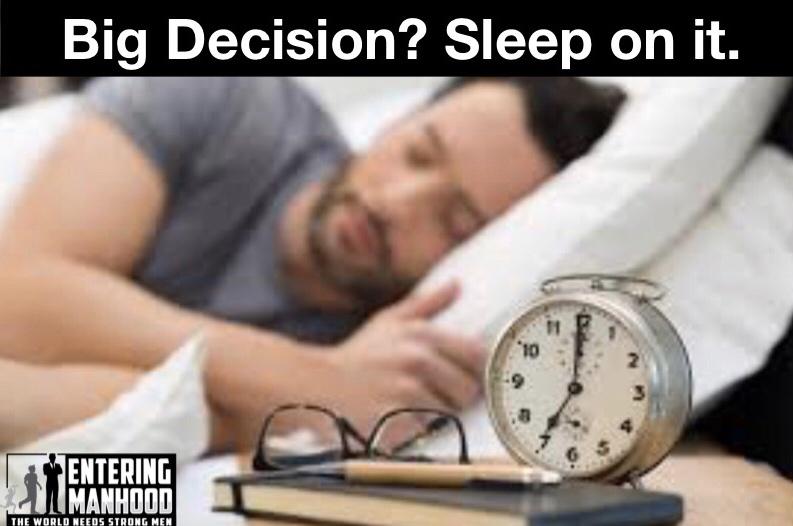
Making a life-altering choice while your brain is fried from a fourteen-hour day is a great way to end up broke, alone, or deeply regretful.
Key Takeaways
- Your brain uses sleep to physically flush out toxins and metabolic waste.
- Unconscious thought often outperforms conscious rumination for complex problems.
- Sleep deprivation mimics the cognitive effects of being legally drunk.
- Taking twenty-four hours before responding to a crisis is a power move, not a weakness.
The Biology of Mental Housekeeping
Old sayings are funny because people repeat them without knowing why they work. "Sleep on it" is one of those phrases said by many but understood by few. If more people understood the rationale behind the saying, logic would reign over impulse. No matter what the situation, if you are ever asked to make an important decision, take the full twenty-four hours of shut-eye due to the biological benefits it creates.
Your brain is a high-energy organ that produces a lot of trash. Research published by the National Institutes of Health suggests that the space between brain cells increases during sleep, allowing the brain to flush out toxins like a plumbing system. This is a housekeeping role that removes the junk that builds up while you are awake. Think of it as sweeping away the trash while the store is closed. If you don’t sleep, you are trying to find a needle in a dumpster. It is a biological bottleneck. You can't out-hustle a brain full of metabolic waste.
The Power of the Unconscious Mind
Conventional wisdom suggests that by sleeping on it, we clear our minds and relieve ourselves of the immediacy and stress of a choice. This is true, but there is more going on under the hood. Research from the University of Amsterdam suggests that for complex decisions—the kind with too many variables to track on a notepad—our unconscious mind is actually better at weighing the options than our conscious logic. I have found that when I tackle problems head-on without a rest period, I focus on the wrong details.
Sometimes, the more consciously we think about a decision, the worse the decision made. We need a period of unconscious thought to simplify the choice so it checks your most important boxes. This period gives your brain an opportunity to organize your memories and process the information you acquired during the day. For certain kinds of decisions, specifically complex ones where you have some existing expertise, the brain makes better unconscious decisions when we let it. You aren't being lazy by going to bed. You are delegating the heavy lifting to a better version of yourself.
The High Cost of Sleep Deprivation
On the flip side, sleep deprivation has some seriously bad side effects. It interferes with brain function at a cellular level. A UCLA study found that sleep deprivation interferes with the ability of some brain cells to communicate with one another. We have billions of neural cells enabling us to make decisions. They process information and help us focus. Sleep deprivation slows that work down, compromising your mental performance. It’s like trying to run a high-end operating system on a dial-up connection.
According to the CDC, being awake for just 17 hours can result in cognitive impairment equivalent to a blood alcohol content of 0.05%. Give it 24 hours, and you are effectively as sharp as someone who is legally drunk. You wouldn't sign a mortgage or handle a breakup after four shots of tequila, yet men try to navigate their entire lives while chronically exhausted. I used to have a boss who stayed in the office until 2 a.m. every night. He thought it made him a machine. In reality, he made increasingly erratic choices that eventually cost the company its best talent and him his marriage. He wasn't a hero; he was just a guy with a foggy brain making bad bets.
Protecting Your Decision-Making Process
Being a man means being responsible for the outcomes you produce. If your decision-making process is compromised, your life will reflect that. We live busy, complicated lives that require us to juggle various responsibilities in a distracting world. It can feel impossible to find time for a few moments of peace to logically evaluate a major choice. Luckly for you, the human body has a built-in function that handles this while you sleep. Even when you are sleeping like a baby, your brain is working hard to organize your thoughts and solve complex problems.
If you don't have a solid routine, you are drifting. I previously discussed how to define your life code, and a big part of that code is knowing when to step back. If someone is pressuring you for an answer right now, the answer should almost always be no. Pressure is usually a sign that someone else’s agenda is more important than your clarity. A man who cannot be pressured into a hasty reaction is a man who is in control of his environment.
The moral of the story is simple: if you want to make the right decision, stop thinking about it, get some sleep, and let your brain do the rest. Silence the noise. Shut off the phone. Your best choice is usually waiting for you at breakfast.
What To Do This Week
- Identify one major looming decision and commit to not answering it until after a full night of sleep.
- Put your phone in another room sixty minutes before you intend to be asleep to lower your cognitive load.
- Keep a notepad by your bed for those 3 a.m. ideas so you can write them down and get back to sleep.
- Practice saying "I’ll get back to you in twenty-four hours" when hit with a request that feels urgent but isn't.
—Your Bro