The Greatest General You Never Learned About: Subutai
Subutai was Genghis Khan’s primary military strategist who conquered more territory than any commander in history without losing a single major battle
By Your Bro · · Guy Stuff
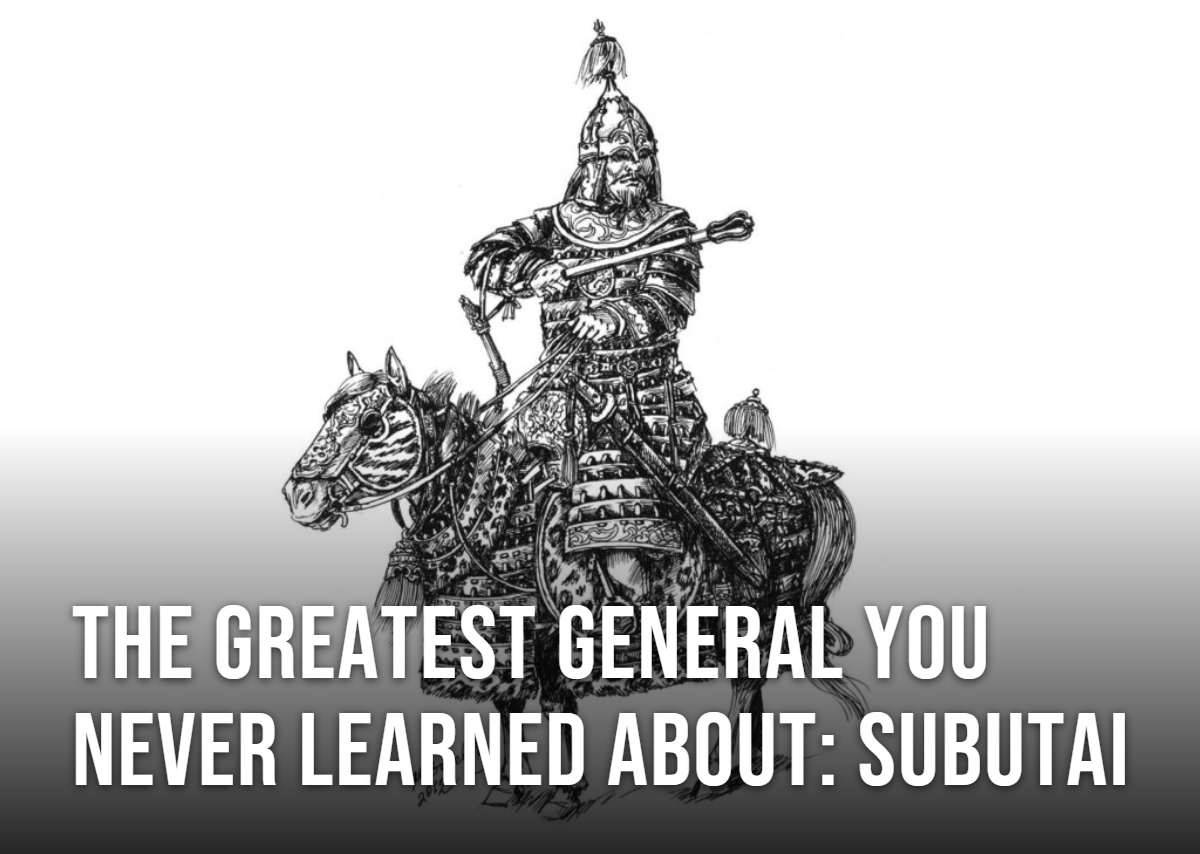
Subutai did not just win battles; he dismantled entire civilizations with the efficiency of a butcher who had a plane to catch.
Key Takeaways
- Subutai conquered more territory than Alexander the Great and Caesar combined.
- He pioneered the use of coordinated, multi-pronged lighting strikes across thousands of miles.
- True tactical genius is about preparation and psychological warfare, not just brute force.
- Victory belongs to the man who can adapt faster than his enemy can panic.
The Architecture of an Unbeatable General
Most people can tell you who Genghis Khan was, but they couldn't tell you how he actually managed to take over the world. Subutai was the how. He was Genghis Khan’s primary military strategist and a man whose resume makes every modern general look like they are playing with plastic soldiers in a sandbox. He was born the son of a blacksmith, not a noble, proving early on that masculine leaders in history are often forged in hard work rather than high birth. He started as a stable boy and ended his life having conquered thirty-two nations and won sixty-five pitched battles.
Research into Mongol logistics shows they could cover up to 80 miles a day on horseback, a speed that was physically impossible for European armies of the time to comprehend. While the knights of Europe were clanking around in heavy steel and worrying about their honor, Subutai was calculating how to starve them out and hit them from three sides at once. He was the first to treat a battlefield like a chessboard where the board was the size of a continent.
Tearing Through Eastern Europe Like Toilet Paper
In the 1220s and 1240s, Subutai tore through Eastern Europe like tearing toilet paper, often with only a scouting force or a fraction of the total Mongol horde. He didn't just charge in. He sent spies months in advance to learn the local politics, the terrain, and exactly which noble hated which other noble. By the time he showed up, he already knew your weaknesses better than your own mother did. This level of preparation is something I touched on when discussing historical heroes you never learned about, because the guys who win are rarely the guys who just show up and hope for the best.
I remember a guy I worked for back in my twenties who ran a massive construction firm. He used to say that if he had six hours to knock down a wall, he’d spend four hours looking at the blueprints and one hour sharpening his sledgehammer. The actual work took thirty minutes. Subutai was that guy, but with kingdoms instead of drywall. He practiced a form of total war that the West wouldn't see again until the blitzkriegs of the 1940s.
The Battle of the Kalka River
The Battle of the Kalka River is perhaps the greatest example of Subutai's genius. He faced a Russian and Cuman force that vastly outnumbered his own. Instead of a direct engagement, he feigned a retreat for nine straight days. He led them on a chase across the steppe until they were exhausted, disorganized, and convinced the Mongols were cowards. Once the enemy was stretched thin and tired, Subutai turned his horses around and erased them from history. It was a masterclass in psychological manipulation.
This wasn't just luck. It was a deep understanding of human ego. He knew that men in power are often blinded by their own perceived superiority. According to data from the Pew Research Center, leadership styles that emphasize adaptability and emotional intelligence—knowing when to push and when to pull—consistently outperform rigid, authoritative structures in modern corporate environments. Subutai was implementing this 800 years before it became a LinkedIn post.
Logistics over Luster
Subutai pioneered the use of the "Yam" system, a sophisticated postal relay that allowed messages to travel across the empire with incredible speed. This meant he could coordinate two armies that were hundreds of miles apart to strike the same city on the same day at the same hour. In an era where communication moved at the speed of a walking man, this was basically magic. He used engineers to build bridges where none existed and used smoke signals to communicate across mountains.
He was consistently selective with his resources. He didn't waste men on pointless sieges if he could trick the gates open. He was a practitioner of the idea that your time is bigger than money—or in his case, your momentum is bigger than your ego. If a city was too strong, he bypassed it, cut off their food, and moved on. He realized that a city was just a cage for people who couldn't fight back.
The Old Man of the Steppe
Even toward the end of his life, when he was too heavy and old to ride a horse comfortably, he commanded from a specialized cart. He was seventy-one years old and still outmaneuvering kings in their twenties. He had seen everything and felt no need to prove himself by doing anything flashy. He just wanted to win. He retired back to the Mongol heartland, lived in a felt tent, and died peacefully in his sleep. For a man who had killed millions, it was the quietest exit possible.
He didn't leave behind a grand monument or a sprawling autobiography. He left behind a legacy of effectiveness. He was a man who understood that your job isn't to look the part; your job is to get results. People today worry so much about their personal brand and their aesthetic that they forget how to actually accomplish a task. Subutai didn't care about his brand. He cared about the map.
What To Do This Week
- Read the Wikipedia entry on the Battle of the Kalka River to understand feigned retreats.
- Identify one area of your life where you are trying to use brute force instead of a better strategy.
- Spend double the time you normally do on preparation before starting your next big project.
- Do something difficult without telling anyone about it or posting it for validation.
—Your Bro